Brick slip external wall insulation in County Durham
We provide brick slip external wall insulation across County Durham, from Darlington and Hartlepool to smaller towns and villages, with a free survey and a fixed written price for every home.
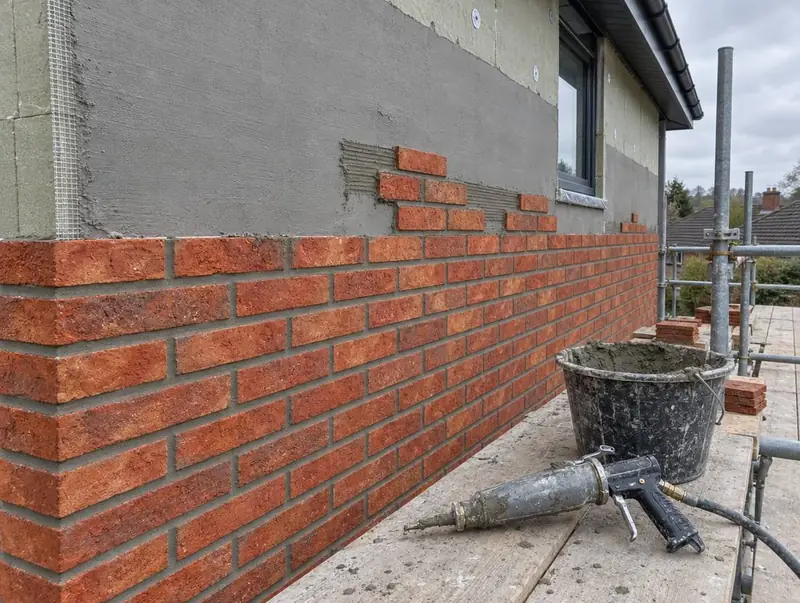
What is brick slip external wall insulation?
Brick slip external wall insulation is an EWI system finished with 10–20mm thick clay brick slips, bonded with adhesive onto a reinforced basecoat over the insulation and then pointed. Corner slips return around external corners so the finish reads as solid brickwork.
Homes across County Durham
Former colliery terraces of solid brick and stone, post-war council estates including non-traditional houses, and Victorian streets in Hartlepool and Stockton.
Most EWI failures start at the edges rather than the middle of a wall, so the quote for your County Durham home sets out how each detail will be built.
We cover 12 towns in County Durham for brick slip external wall insulation, listed below, and the villages around them.
Prices in County Durham
Guide prices for brick slip external wall insulation in County Durham run from about £185 to £265 per square metre installed, slips and pointing included; scaffolding priced per house, with VAT at 0% on homes until 31 March 2027.
Whole-house prices include standard scaffolding, beads, sills and refitting services; unusual access, footpath licences and wall repairs are quoted separately.
Specification
- Finish
- Real clay brick slips, 10–20mm
- Bond
- Stretcher, Flemish-effect or to match
- Corners
- L-shaped corner slips
- Insulation underneath
- EPS or mineral wool, as certified
- Weight
- Heavier than render; anchor pattern checked
- Best for
- Brick streets, planning-sensitive fronts
Why choose it
- Keeps a real brick appearance
- Often an easier route through planning than render on brick streets
- Very durable, low-maintenance face
- Can mix with render on side and rear walls to manage cost
Can brick slips match my existing bricks?
Slips come in a wide range of colours and textures, and a close match is often possible. An exact match to weathered Victorian brick is hard; we bring samples to the survey and you see them against your wall in daylight before ordering.
Why is a brick slip finish more expensive?
Slips are a material cost on their own, they are laid by hand course by course, corners need special pieces, and the whole face is pointed. Expect brick slip finishes to cost noticeably more per square metre than render.
Other services in County Durham
- EWI installation
- EPS insulated render
- Mineral wool EWI
- Phenolic EWI
- Wood fibre EWI
- Insulated cladding
- Insulating lime render
- Silicone render finish
- Mineral & silicate render
- Pebbledash & dry dash EWI
- Solid wall insulation
- Non-traditional houses
- Bungalow EWI
- Terraced house EWI
- Semi-detached EWI
- Detached house EWI
- Park home insulation
- Flats & low-rise blocks
- Social housing EWI
- EWI for landlords
- EWI repairs
- Failed EWI remediation
- EWI surveys
Towns in County Durham
- Billingham
- Bishop Auckland
- Chester-le-Street
- Consett
- Darlington
- Durham
- Hartlepool
- Newton Aycliffe
- Peterlee
- Seaham
- Stanley
- Stockton-on-Tees
The rules in England
- Planning
- On a house, external wall insulation is usually permitted development if the finish looks similar to the existing walls. Render or cladding on a house in a conservation area, National Park, National Landscape (AONB), the Broads or a World Heritage Site needs planning permission. Flats and maisonettes have no householder permitted development rights, listed buildings need listed building consent, and an Article 4 direction can remove rights locally.
- Building regulations
- Insulating more than half of a wall, or more than a quarter of the whole building envelope, counts as renovating a thermal element under the Building Regulations, so the wall should reach 0.30 W/m²K where that is technically, functionally and economically feasible, and building control must be involved.
- Fire safety
- On houses and other residential buildings up to 11m, Approved Document B sets surface rules only within 1m of a boundary. Residential buildings with a storey 11m or more above ground should have insulation of class A2-s1,d0 or better, and combustible materials are banned in the external walls of relevant buildings with a storey at least 18m up.
- Funding
- Low-income households in homes rated below EPC C can apply for Warm Homes: Local Grant where their council is taking part. The Great British Insulation Scheme closed on 31 March 2026, and ECO4 closes on 31 December 2026; its final months are for finishing and putting right existing work. Grant schemes use their own approved installers, so check a scheme's installer rules before booking; our quotes are for privately funded work unless we confirm otherwise in writing. Grants guide
- VAT
- Installing insulation in a home is zero-rated for VAT until 31 March 2027, then 5%.
Checked October 2026. Rules change, so we confirm them for your address at survey.
Questions about brick slip external wall insulation
Do brick slips need planning permission?
Where they look similar to the existing brick, a brick slip finish is more likely to fall within permitted development on a house in England. In conservation areas and on flats, check first.
Can brick slips go on mineral wool?
Yes, where the system holder certifies the combination. Mineral wool with brick slips is used on low-rise blocks.
Can I do the front in slips and the rest in render?
Yes. It is a common way to keep the street face in brick and control the cost.
How long does the work take?
Two to six weeks on site for most houses, depending on size: bungalows are quicker, detached houses longer.