What is external wall insulation and how does it work?
The short answer
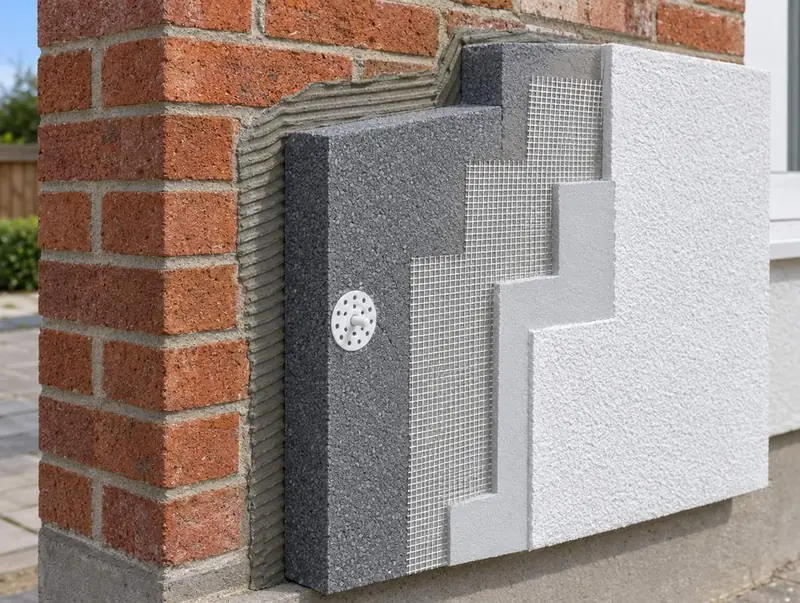
External wall insulation (EWI) is a system of insulation boards fixed to the outside of a wall and protected by a mesh-reinforced render, brick slips or cladding. It reduces heat loss through the wall, keeps the inside wall surface warmer, and leaves your rooms untouched.
The layers, from the wall outwards
A typical rendered system has six parts. A starter track is fixed above the damp-proof course. Adhesive bonds the boards to the wall. Insulation boards (EPS, mineral wool, phenolic or wood fibre) go on with staggered joints and are held with mechanical anchors. A basecoat with a glass-fibre reinforcing mesh embedded in it gives the system its strength. A primer and a thin finish coat (silicone, mineral or dash) make it weatherproof and decorative.
Around that build-up sit the details that make it work: beads at corners and edges, extended window sills, insulated reveals where there is room, and a roofline that throws rain clear of the new wall face.
What does EWI actually improve?
A solid 225mm brick wall has a U-value of around 2.0 W/m²K. With around 90–110mm of EPS it can reach 0.30 W/m²K, the standard England's building regulations ask for when a wall is renovated. That is a reduction of roughly 85% in heat flow through the wall. Inside, the wall surface becomes warmer, which makes rooms feel more comfortable at the same thermostat setting and reduces condensation on cold walls.
How much that saves on bills depends on your heating, how you use the house, and energy prices. Treat any fixed £ saving figure with caution, including ours.
Which homes suit EWI?
EWI is mainly used on walls with no cavity to fill: solid brick and stone houses built before the 1930s, and post-war system-built homes such as no-fines concrete and steel-framed houses. It can also go on cavity walls that can't take cavity fill. It is less suitable where walls are damp, structurally unsound, or where the appearance can't change, for example many listed buildings.
External or internal wall insulation?
Internal insulation is cheaper per square metre but takes floor space from every outside wall and means refitting kitchens, radiators and sockets. External insulation keeps your rooms the same, covers floor and partition junctions that internal insulation can't, and gives the house a new exterior, but it changes how the house looks and needs scaffolding.
Related services
Questions people ask
Is EWI the same as rendering?
No. Render alone is a weather coat. EWI adds insulation boards under a reinforced render, and has to meet the energy standards for renovated walls.
How thick is external wall insulation?
Typically 70–160mm including the finish, depending on the board and the U-value targeted.
Does EWI need planning permission?
Often not on a house in England if it looks similar to the existing walls, but it does in conservation areas and other designated land, on flats, and on listed buildings. Rules differ in Wales, Scotland and Northern Ireland.