EWI U-values: how thick does external insulation need to be?
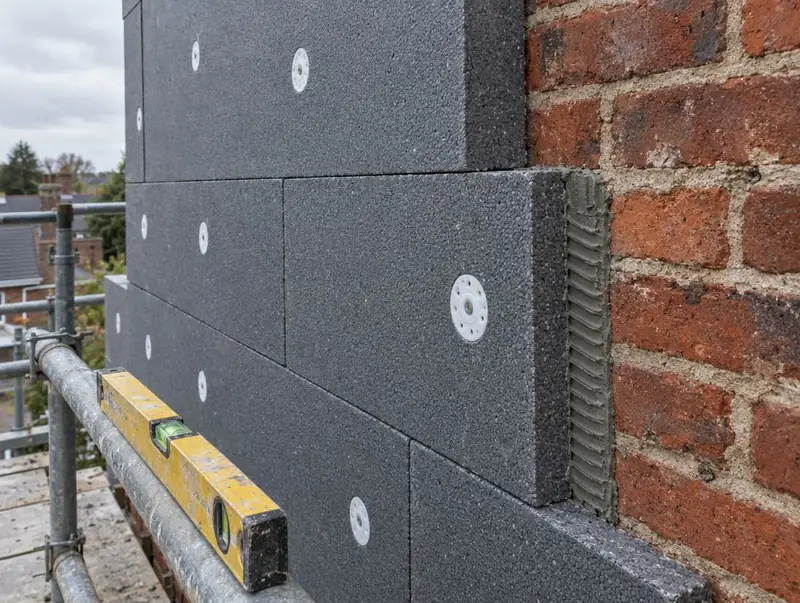
The short answer
To bring a typical 225mm solid brick wall (around 2.0 W/m²K) to 0.30 W/m²K, you need roughly 55–65mm of phenolic, 90mm of graphite EPS, 110mm of white EPS, 100–120mm of mineral wool or 120–140mm of wood fibre. Going thicker improves the U-value further, with diminishing returns.
What a U-value means
A U-value measures how much heat passes through a square metre of wall for each degree of temperature difference, in W/m²K. Lower is better. A solid 225mm brick wall is around 2.0; a modern new-build wall is around 0.18 or lower.
Thickness by board for 0.30 W/m²K
| Board | Conductivity (W/mK) | Approx. thickness on solid brick |
|---|---|---|
| Phenolic | ≈0.020–0.023 | 55–65mm |
| Graphite EPS | ≈0.031–0.032 | ≈90mm |
| White EPS | ≈0.038 | ≈110mm |
| Mineral wool | ≈0.035–0.041 | 100–120mm |
| Wood fibre | ≈0.040–0.046 | 120–140mm |
Figures are approximate; anchors, adhesive and the exact wall change the result. Your quote states the calculated U-value for your wall.
Is thicker always better?
Doubling insulation does not halve heat loss twice over. Beyond about 0.25 W/m²K, extra thickness saves less and costs more in sills, eaves and reveals. Where space is tight, the regulations allow the best reasonable standard.
Related services
Questions people ask
What U-value do building regulations require?
In England, 0.30 W/m²K for a renovated wall where feasible.
Does render add insulation?
Only a little. The boards do the work.