External wall insulation and fire safety
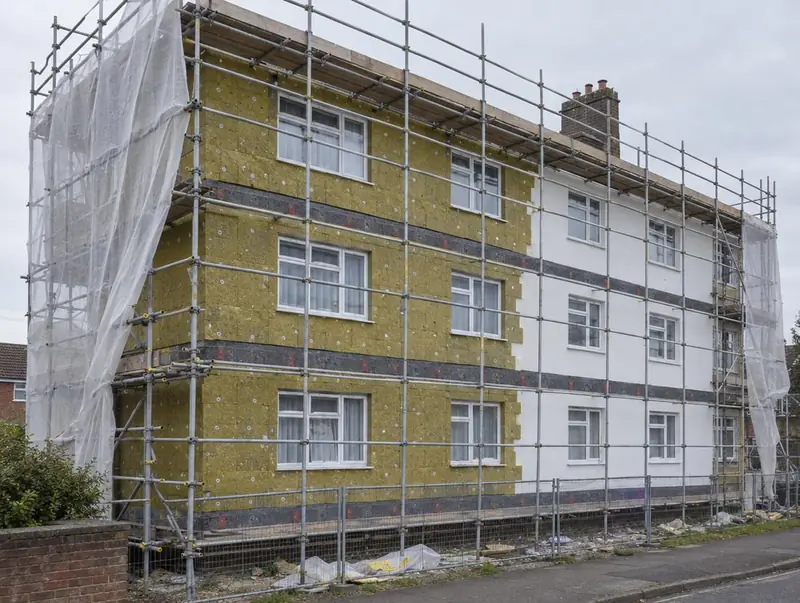
The short answer
Fire rules for external walls depend on building height, use and distance to the boundary. In England, residential buildings with a storey 11m or more above ground should use insulation of class A2-s1,d0 or better, and combustible materials are banned on relevant buildings with a storey at least 18m up. On houses below 11m, surface rules apply within 1m of a boundary.
Reaction-to-fire classes
Products are classed from A1 (non-combustible) through A2, B, C, D and E to F. Suffixes describe smoke (s1–s3) and flaming droplets (d0–d2). Mineral wool is typically A1 or A2; EPS, phenolic and wood fibre are combustible and are used within the limits of their tested system.
England
- Houses and residential buildings up to 11m: outer surface within 1m of the boundary should be B-s3,d2 or better; no surface provisions beyond 1m.
- Residential buildings with a storey 11m or more: outer surface and insulation A2-s1,d0 or better.
- Relevant buildings with a storey at least 18m (with dwellings, institutions or rooms for residential purposes): regulation 7(2) bans combustible materials in the external wall.
Scotland
Cladding on domestic buildings with any storey more than 11m above ground should be European Classification A1 or A2. Below 11m, combustible cladding is allowed more than 1m from a boundary, with stricter rules closer to it.
Fire breaks and system design
EPS systems on houses often include non-combustible fire breaks at certain positions as part of the system holder's design. Following the certified system exactly matters as much as the board itself.
Related services
Questions people ask
Is EWI on my semi a fire risk?
A certified system installed to its design on a house below 11m meets the guidance for that building type.
Do you work on tall buildings?
We work on houses and low-rise blocks. We don't take on higher-risk buildings (18m+ or seven storeys with two or more homes).