EPS vs mineral wool: which EWI board should you choose?
The short answer
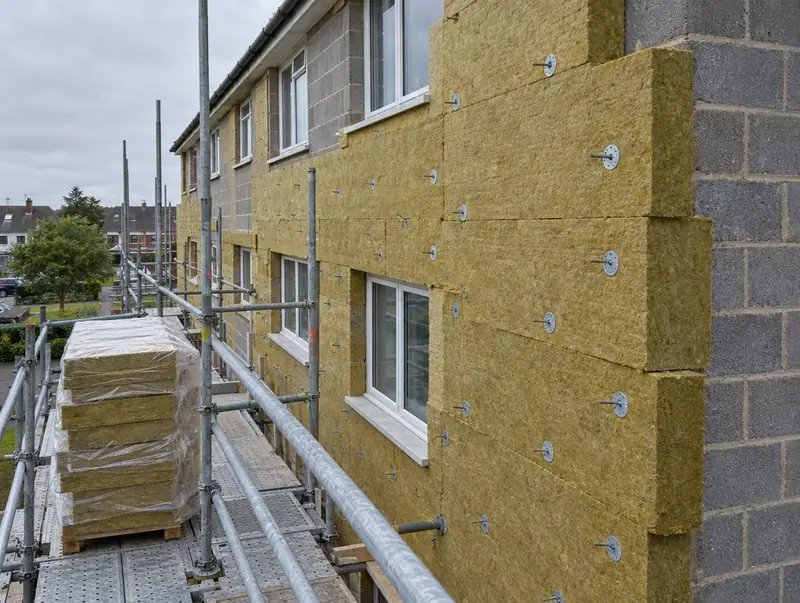
EPS is lighter, cheaper and slightly thinner for the same U-value, and suits most houses below 11m. Mineral wool is non-combustible, vapour-open and better for noise, and it is required on residential buildings with a storey 11m or more above ground in England and on most blocks and close boundaries.
Comparison
| EPS (graphite) | Mineral wool | |
|---|---|---|
| Thermal conductivity | ≈0.031–0.032 W/mK | ≈0.035–0.041 W/mK |
| Thickness for 0.30 on solid brick | ≈90mm | ≈100–120mm |
| Reaction to fire | Combustible | Typically A1 or A2-s1,d0 |
| Vapour | Moderately resistant | Vapour-open |
| Weight | Very light | Heavier, more anchors |
| Cost per m² installed | £109–£149 | £129–£175 |
When the choice is made for you
On residential buildings with a storey 11m or more above ground in England, insulation should be A2-s1,d0 or better, so mineral wool it is. Scotland requires A1 or A2 cladding where any storey is more than 11m up. On houses, close boundary positions and the system holder's certificate can also point to mineral wool.
Old walls and breathability
On older solid walls built with lime, vapour-open systems (mineral wool, or wood fibre) let moisture dry outwards. EPS works well on sound, dry cement-mortared brick, which describes most inter-war and post-war houses.
Related services
Questions people ask
Is mineral wool always better?
No: it is safer in fire and more breathable, but costs more and is heavier. On a typical semi below 11m, EPS is a sound choice.
Can I mix boards?
Some systems allow mineral wool fire breaks within an EPS system, or different boards on different elevations. Follow the system holder's design.