External wall insulation in Wiltshire
We provide external wall insulation across Wiltshire, from Swindon and Salisbury to smaller towns and villages, with a free survey and a fixed written price for every home.
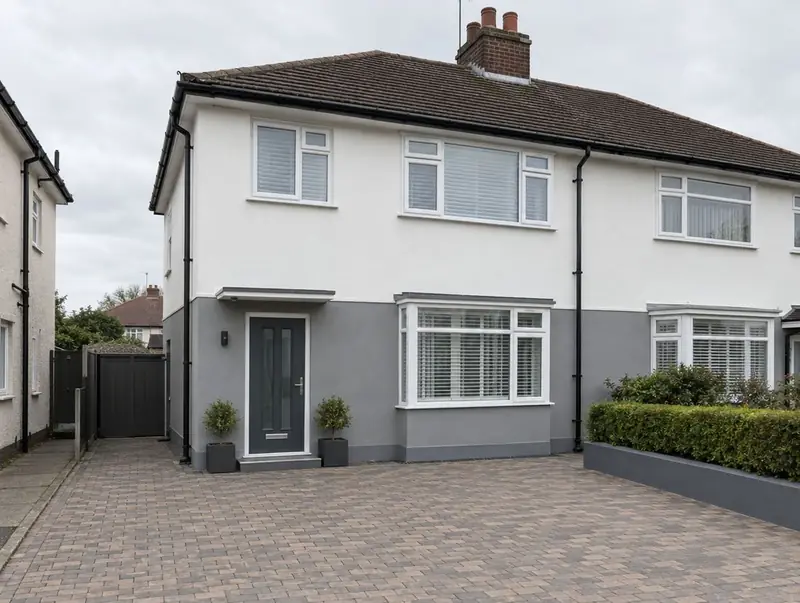
Homes across Wiltshire
Stone villages, Salisbury's historic centre, Swindon's railway terraces and post-war estates, and National Landscapes across the county.
We photograph every hidden layer as it goes on, so you have a record of what's behind the finish on your Wiltshire home.
Services in Wiltshire
- EWI installation
- EPS insulated render
- Mineral wool EWI
- Phenolic EWI
- Wood fibre EWI
- Brick slip EWI
- Insulated cladding
- Insulating lime render
- Silicone render finish
- Mineral & silicate render
- Pebbledash & dry dash EWI
- Solid wall insulation
- Non-traditional houses
- Bungalow EWI
- Terraced house EWI
- Semi-detached EWI
- Detached house EWI
- Park home insulation
- Flats & low-rise blocks
- Social housing EWI
- EWI for landlords
- EWI repairs
- Failed EWI remediation
- EWI surveys
Towns we cover in Wiltshire
The rules in England
- Planning
- On a house, external wall insulation is usually permitted development if the finish looks similar to the existing walls. Render or cladding on a house in a conservation area, National Park, National Landscape (AONB), the Broads or a World Heritage Site needs planning permission. Flats and maisonettes have no householder permitted development rights, listed buildings need listed building consent, and an Article 4 direction can remove rights locally.
- Building regulations
- Insulating more than half of a wall, or more than a quarter of the whole building envelope, counts as renovating a thermal element under the Building Regulations, so the wall should reach 0.30 W/m²K where that is technically, functionally and economically feasible, and building control must be involved.
- Fire safety
- On houses and other residential buildings up to 11m, Approved Document B sets surface rules only within 1m of a boundary. Residential buildings with a storey 11m or more above ground should have insulation of class A2-s1,d0 or better, and combustible materials are banned in the external walls of relevant buildings with a storey at least 18m up.
- Funding
- Low-income households in homes rated below EPC C can apply for Warm Homes: Local Grant where their council is taking part. The Great British Insulation Scheme closed on 31 March 2026, and ECO4 closes on 31 December 2026; its final months are for finishing and putting right existing work. Grant schemes use their own approved installers, so check a scheme's installer rules before booking; our quotes are for privately funded work unless we confirm otherwise in writing. Grants guide
- VAT
- Installing insulation in a home is zero-rated for VAT until 31 March 2027, then 5%.
Checked October 2026. Rules change, so we confirm them for your address at survey.
External wall insulation in Wiltshire: questions
How much does external wall insulation cost in Wiltshire?
Guide prices run from about £109 to £175 per square metre for the system and finish, plus scaffolding. For an average home that's about £8,595–£11,695 for a mid-terrace, £13,995–£19,195 for a three-bed semi and £20,495–£28,095 for a four-bed detached house, with VAT at 0% on homes.
How long does external wall insulation take?
It depends on the size of the house and the weather: bungalows usually take one to two weeks on site, terraces two to three, semis three to four and detached houses four to six. Blocks of flats take longer.
Can I stay at home during the work?
Yes. All the work is outside, so you can live at home as normal while the scaffolding is up.
What finishes can I choose?
Silicone or mineral render in many colours, pebbledash, brick slips or cladding, alone or combined.